
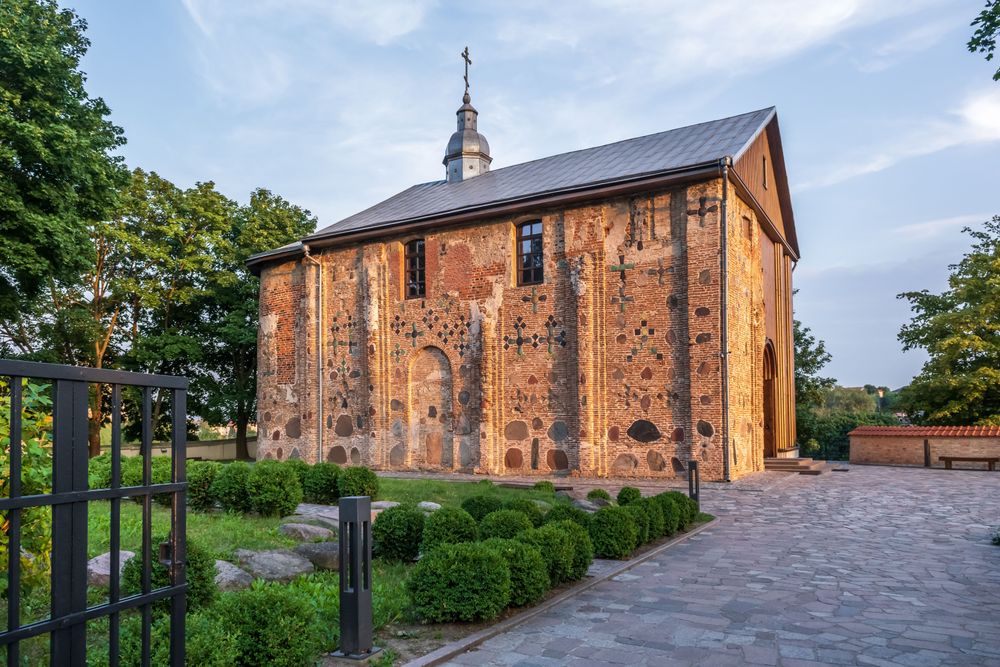
Kalozha Church of Saints Boris and Gleb
6 Kalozha Street
The Kalozha Church of Saints Boris and Gleb is one of the oldest and most remarkable monuments of medieval architecture in Eastern Europe.
The church was built in the 12th century, during the time of the Hrodna Principality, and dedicated to Saints Boris and Gleb, whose cult was widespread across the lands of Eastern Slavs.
The construction of the church is often associated with the architect Pyotr Miloneg, who was invited by local princes to the city then known as Goroden.
Miloneg and his team built several churches here, but Kalozha is the only one that has survived.
Originally the church was a cross-domed structure with three semicircular apses and six columns. The altar traditionally faces east.
The building was constructed using plinfa, a narrow brick typical of construction in the 10th–13th centuries. Some of the bricks still bear raised symbols resembling letters or pictograms. Historians believe these marks probably indicated different batches of bricks used during construction.
The church has a very distinctive appearance. It was built in the Byzantine architectural tradition, which spread across Eastern Europe after the adoption of Christianity.
At the same time, local builders combined Byzantine techniques with their own artistic traditions. As a result, scholars speak of a unique Hrodna School of Architecture.
Polished stones were inserted directly into the walls of the church. The brickwork is also decorated with crosses made of colored ceramic tiles covered with glaze — majolica.
Originally the floor of the church was also covered with colorful majolica tiles.
The famous Belarusian writer Vladimir Karatkevich, in his novel Christ Landed in Hrodna, compared the church to a rainbow.
Inside the thick walls of the church are large ceramic jars built into the masonry. They lie horizontally with their necks facing inward.
These jars perform several functions: they reduce pressure from the vaults, help regulate temperature, and improve acoustics. Because of this they are called “golosniki,” or resonating vessels.
This architectural innovation dates back to Ancient Rome.
While most churches used only a few such vessels, the Grodno architectural tradition embedded dozens of them into the walls, making the church unique.
The Polish writer Zygmunt Gloger, who visited Kalozha in 1872, wrote that all the walls once contained such jars. He also described an unusual tradition: visitors could pay a few coins to shout inside the church and test its remarkable acoustics. This fee was jokingly called a “sound tax.”