
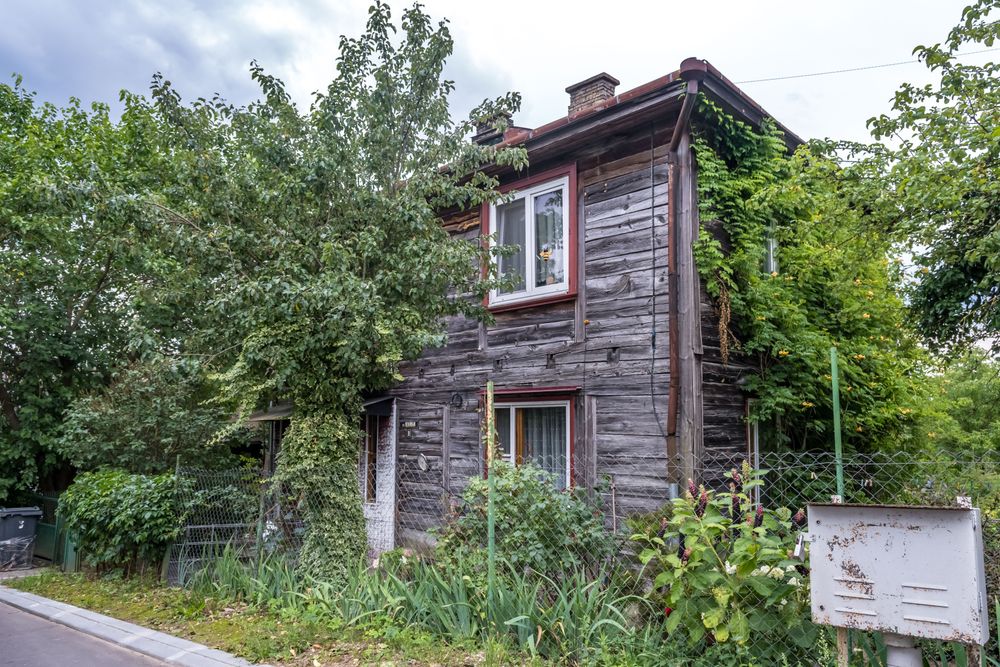
Teachers’ Colony
11 Chkalova Street
If we step slightly away from the main route, turn right, and walk around the school building, we will reach an area to the west that was historically known as the Teachers’ Colony.
During the interwar period these streets were named after the Polish aviators Franciszek Żwirko and Stanisław Wigura, who tragically died in an air crash. After Grodno became part of the Belarusian Soviet Socialist Republic, the streets were renamed after Soviet pilots Valery Chkalov and Polina Osipenko, whose fates symbolically echoed those of the Polish aviators.
Despite its name, this district had nothing to do with imprisonment or confinement. The name “Teachers’ Colony” appeared simply because many teachers lived here.
In the 1920s and 1930s, around ten wooden houses were built here according to a special project for teachers working in Grodno’s educational institutions. Each two-storey building contained several apartments with spacious bright rooms, verandas, and separate entrances.
These houses were built in the constructivist style, which became popular after the First World War and reflected the spirit of the industrial age. Simple geometric shapes — cubes, parallelepipeds, and cylinders — along with flat roofs and large windows became defining features of this architectural movement.
However, Grodno developed its own unique variation of this style. While constructivist buildings in countries such as Germany, the United States, and the Soviet Union were typically built from concrete, glass, and steel, the houses here were constructed from wood.
Seven of these houses have survived to the present day. Wooden constructivism is extremely rare in world architecture, giving this neighborhood architectural value on a European scale.
After exploring the Teachers’ Colony, we return to Lermontova Street.