
Interwar Residential Quarter
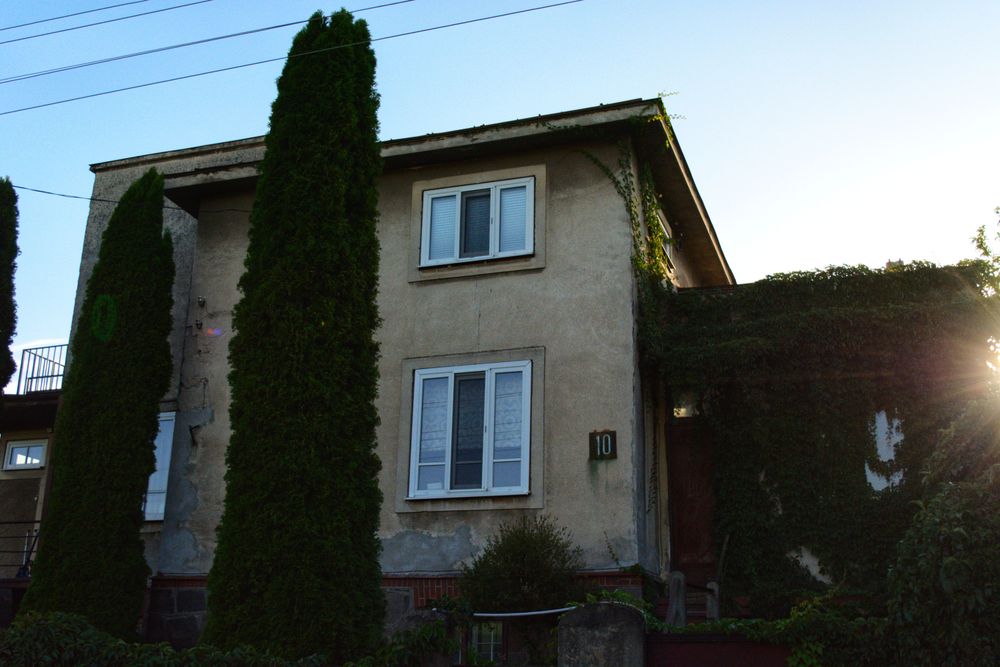
10 Tseglyanaya Street and 3 Tseglyany Lane
Between the Gorodnichanka River and Kalozha Park lie several streets that have preserved their historical names.
On the high right bank of the river runs Zavershchizna Street. Its name comes from an estate that once belonged to the local noble Zaversky family.
According to the historian Józef Jodkowski, in the garden pavilion of Andrei Zaversky there was once a 17th-century marble slab from Grodno Castle, which served as a table.
After the destruction of the estate in the 19th century, brick factories appeared on this site. They gave their names to Tsegliana Street and Tsegliany Lane.
Here you can see unusual examples of wooden constructivist architecture, such as the houses at 10 Tsegliana Street and 3 Tsegliany Lane.
We now reach Lermontova Street, which began to develop as part of the so-called Suburban Sloboda in the second half of the 19th century.
Several industrial enterprises once operated here, including brick factories owned by Badylkes, Anders, and Batkovsky, as well as a soap factory belonging to Kuryansky.
During the interwar period the street was called Bazilianskaya Street, because it led to the Kalozha Church, which in the 17th–19th centuries belonged to the Basilian Order of Greek-Catholic monks.
In the 1920s and 1930s, the former industrial area was gradually replaced by a district of mostly wooden private houses.
The central feature of the quarter is the long one-storey wooden school building at 31 Lermontova Street, decorated with a continuous horizontal row of windows.
In the post-war years, several houses in the area were occupied by members of the Soviet party elite.