
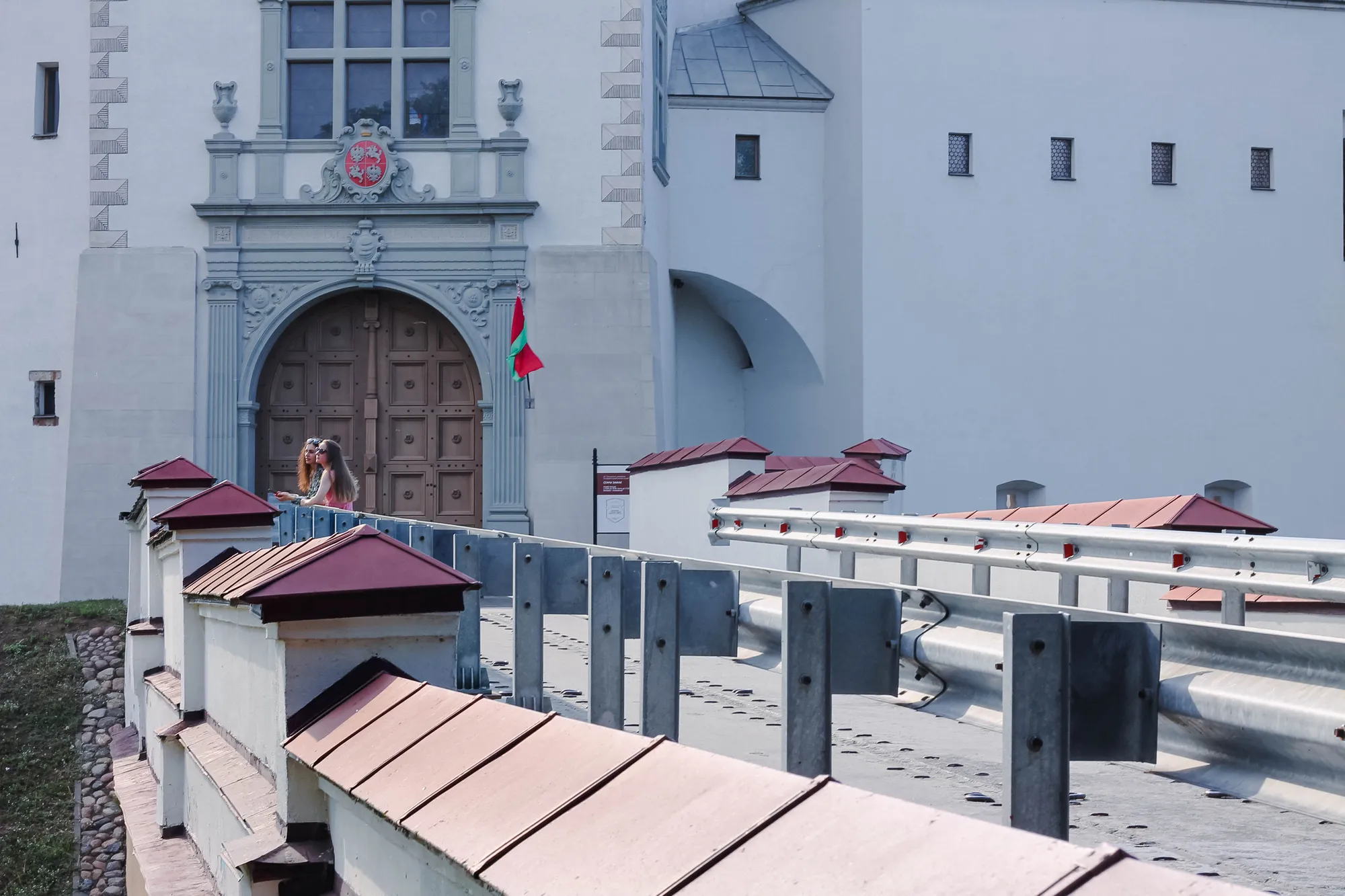
On the bridge in front of the Old Castle gate
Zamkovaya Street, 22
The Old Castle that we see today was built in 1583–1586 by order of King of the Polish–Lithuanian Commonwealth Stephen Báthory. It was a majestic building with a high gabled roof. In the center of the façade was a grand staircase leading to the second floor. On both sides were bay windows with six windows each. The façades were decorated with two-tone sgraffito patterns.
On the first floor there were ten rooms. In the center were square entrance halls — the only access to a small, isolated treasury chamber.
On the second floor were the royal chambers: residential and ceremonial, including the bedroom. These halls were spacious, with high ceilings decorated with ornamental stucco. The floors were covered with marble or glazed tiles, and the fireplaces and stoves were distinguished by carved and tiled decoration.
🔍 Pay attention: A stone bridge with a drawbridge section near the gates led to the castle. Above the arch was a chapel with a copper dome.
On the Neman side, a tower from the time of Vytautas has survived. It housed the royal bath, and above it was the “alabaster hall” — the king’s favorite place of rest. On the cape were the kitchen and bakery. The apartments of the senior palace servant adjoined the northern wing.
Here Stephen Báthory received foreign ambassadors and set out on hunting trips. It was in this castle that he fell seriously ill and died on December 12, 1586.
Historical fact: In 1673, it was decided that every third Sejm of the Polish–Lithuanian Commonwealth would be held in Grodno. The Old Castle became the site of important state events.
After the destruction of the mid-17th century, the castle required repairs. Over five years, it was restored under the supervision of the Chancellor of the Grand Duchy of Lithuania, Krzysztof Pac. On the Neman side, a new building with two halls — the Deputies’ Hall and the Senate Hall — was erected. In 1699, the last Sejm in the Old Castle was held there.
In the 19th and early 20th centuries, the castle was used by the military. In 1925, it was transferred to civilian authorities, and archaeological and architectural research began. From 1945 to 2019, the main exhibition of the Grodno State Historical and Archaeological Museum operated here.
Since November 2021, a new exhibition has been open in halls restored according to the design of architect Vladimir Bachkov. As of summer 2025, a project is underway to restore the palace to its appearance during the reign of Stephen Báthory.