
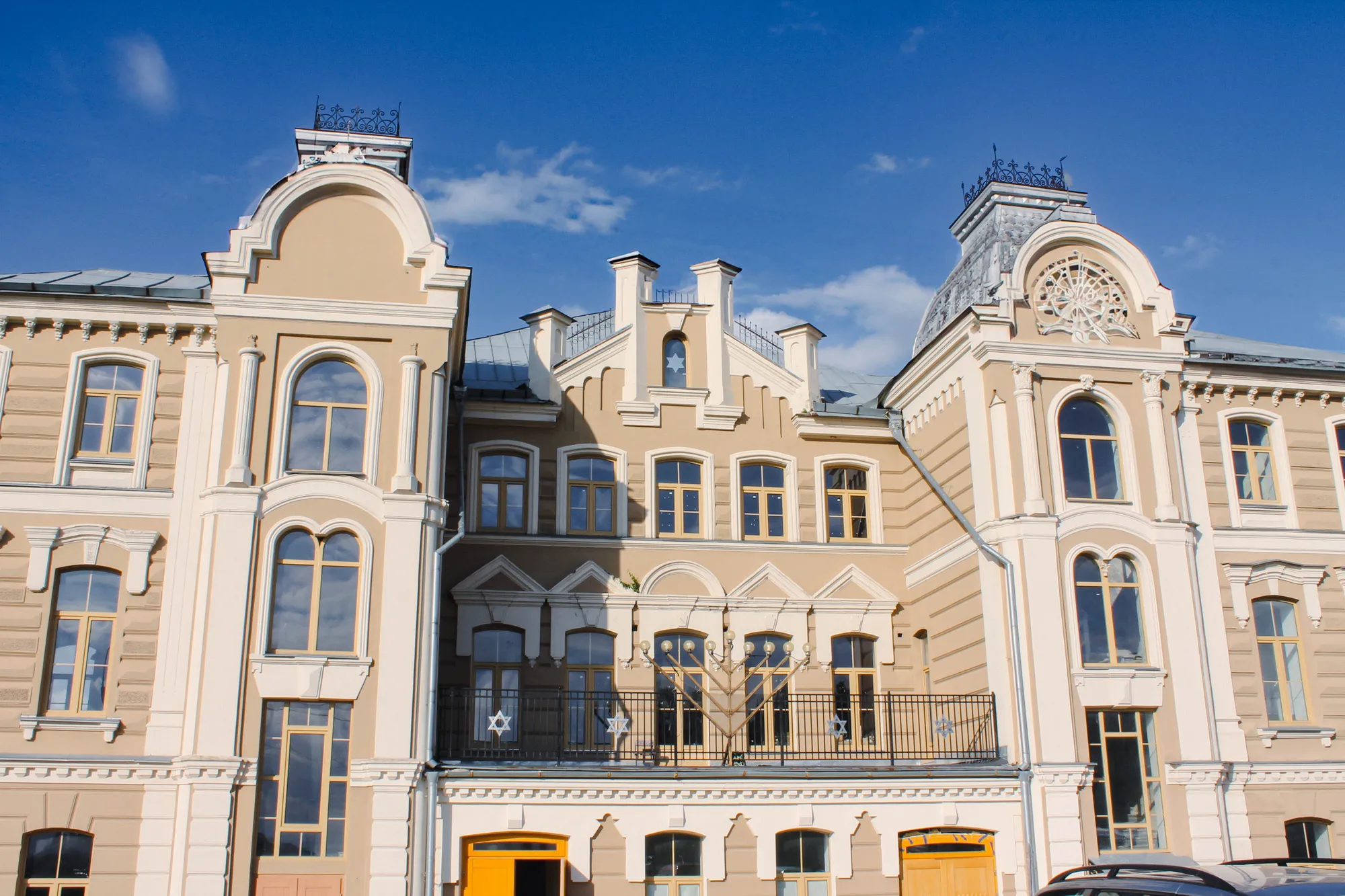
The Synagogue
Bolshaya Troitskaya Street, 59A
The Main Synagogue of Chaim Adam. One of the largest monuments of Jewish architecture in Belarus.
The first wooden synagogue appeared on this site in 1578. The building featured a spacious prayer hall and women’s galleries along the sides.
In 1617, it was destroyed in a major city fire.
📜 Construction of the Stone Synagogue
In 1619 and 1633, the Jewish community of Grodno received royal privileges from King Sigismund III Vasa to build a stone synagogue.
It was presumably designed by architect Santi Gucci in the Renaissance style with elements of Mannerism.
🔨 Reconstructions and Alterations
In the 1740s, during a major renovation:
● internal walls were dismantled ● small towers and an entrance gallery were added ● the women’s section was moved to a gallery (in keeping with architectural trends of the time)
🔥 Fire and Restoration
In 1899, the building was again damaged by fire.
In 1902, the synagogue was restored according to the design of architect Moisei Lubicz.
Only the load-bearing walls of the old structure survived. The new appearance combined elements of Eclecticism and Art Nouveau.
🚫 Closure and Use in the 20th Century
● In 1940, the synagogue was closed ● During the German occupation, the second floor housed a hospital for Jews from the ghetto ● Later, it served as a transit point before deportation to death camps ● In Soviet times, the building was used as a public facility ● In 1958, the second floor was transferred to art workshops ● Until 1967, part of the building was occupied by a pharmaceutical warehouse
📅 Since December 16, 1992, the building has officially been returned to the Jewish religious community.
🏛 Architecture
● The central prayer hall is covered with cross vaults ● In the center stands the bimah (platform for reading the Torah) supported by four pillars ● The interior is restrained yet expressive, with elements of traditional Jewish architecture
📷 Pay attention: The Grodno Synagogue is one of the best preserved and largest in Belarus. It is not only a religious monument but also an essential part of the city’s Jewish cultural heritage.