
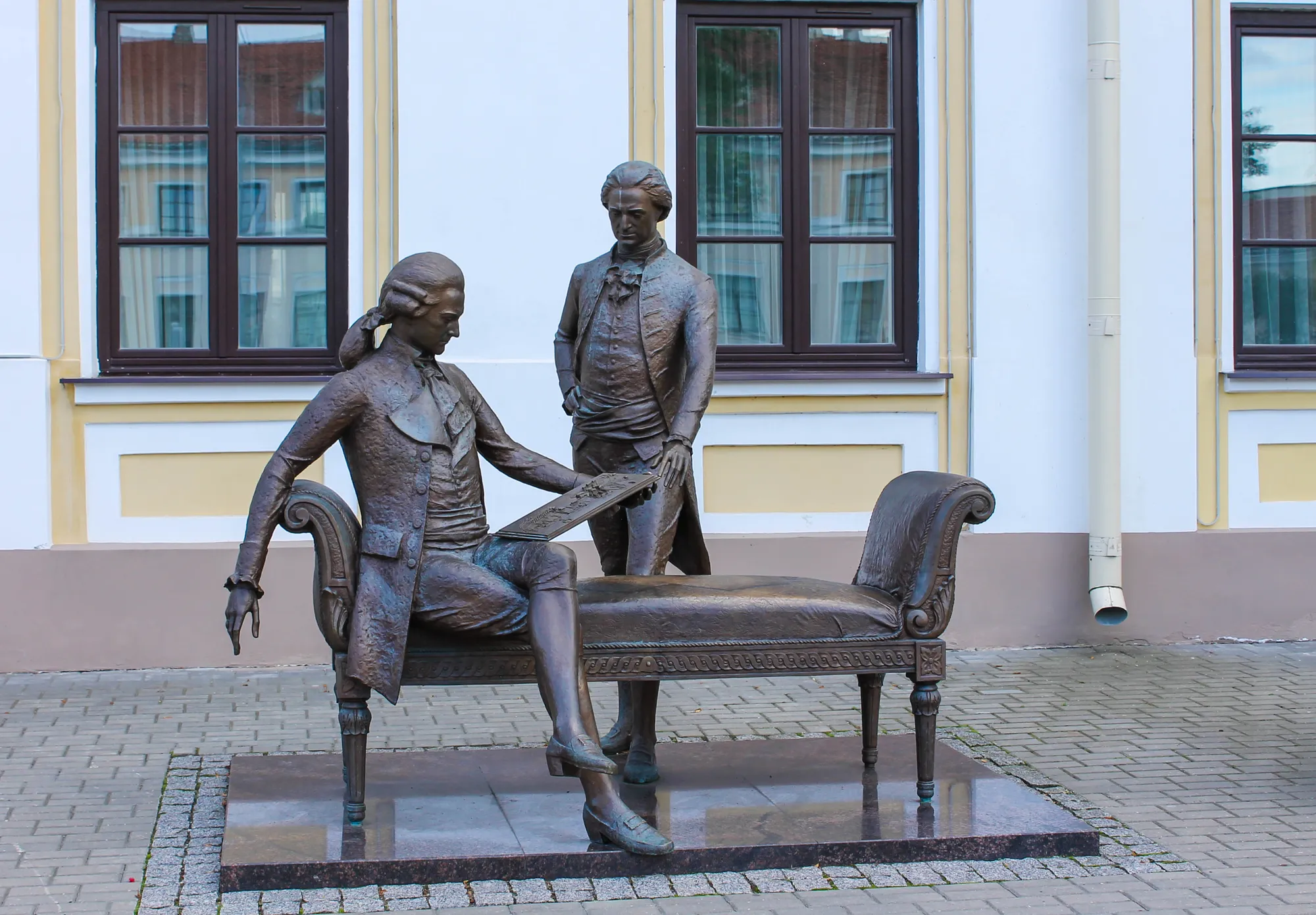
Tyzenhauz Square
Antoni Tyzenhaus Square, 4
From Enlightenment Ideal to Historic Ensemble
This square is one of the most vivid examples of Enlightenment urban planning brought to life. It began forming in the 1760s–1780s at the initiative of Antoni Tyzenhauz, who sought to transform Grodno into a progressive European city.
🏛 Creation of the Square
Tyzenhauz launched a large-scale reform of the urban environment. He chose the territory of the royal folwark for development and commissioned architects Johann Mezer and Giuseppe Sacco.
Thus emerged the new district — Gorodnitsa: the administrative and cultural center of the “new Grodno.” The square was designed according to late Baroque principles:
- clear symmetry,
- enclosed spatial composition,
- unified architectural style.
It symbolized order, authority, and culture.
🏢 Changing Names
Over time, the square changed names: Governor’s Square (when Tyzenhauz Palace became the governor’s residence), Palace Square, Lenin Square after World War II, and since 1992 — Tyzenhauz Square again.
🏛 What Has Survived
From the original 18th-century ensemble, buildings No. 2/2, 3, 3a, 4, 4b, and 5 remain. They have changed little externally and still define the architectural appearance of the square. Lost: building No. 2/1, which housed a psychiatric hospital in the 19th century.
🎶 The Musical Wing — “Krivaya Oficyna”
One of the most distinctive buildings is the musical wing, also known as:
- “Krivaya Oficyna,”
- the theatrical oficyna,
- Khlyudnevich House,
- Vilnius Land Bank.
Built around 1765, it follows the curve of the square. Here Antoni Tyzenhauz established a music school that trained performers for the Grodno theatre.
🎻 The School Curriculum
Students — children of townspeople and serfs — studied:
- violin, flute, cello, trumpet, French horn,
- singing and dance,
- composition and music theory,
- French and Italian,
- drawing, arithmetic, writing.
It was a new type of school — combining enlightenment, art, and social mobility.
📷 Take note: Tyzenhauz Square is a unique example of an 18th-century urban planning concept successfully realized. Despite wars and changes, it has preserved its layout, architecture, and atmosphere.