
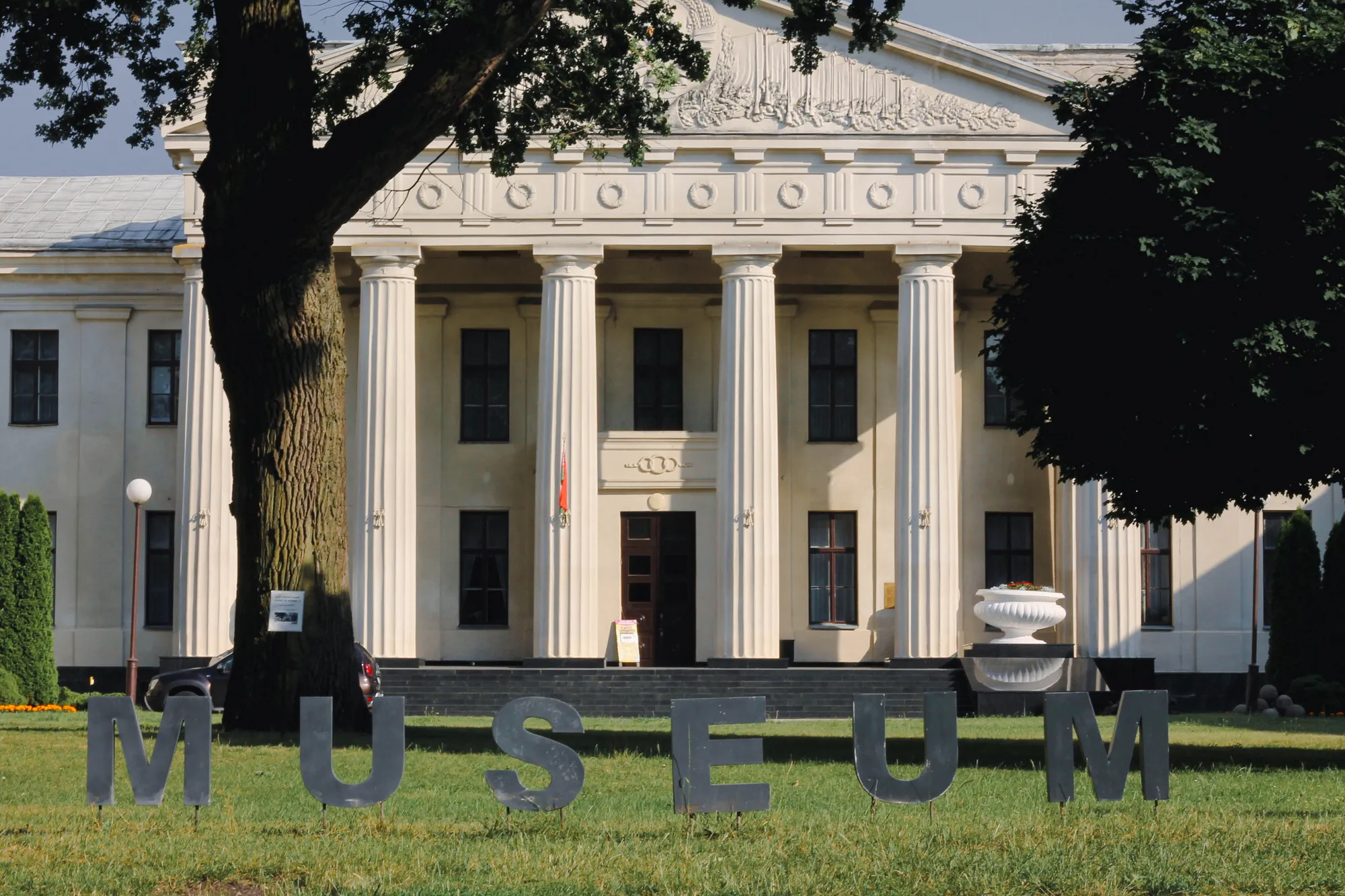
The New Castle is at the entrance to the palace
Zamkovaya Street, 20
Lower Castle, New Castle, military hospital, regional committee of the Communist Party of Belarus, historical and archaeological museum, regional library.
The New Castle was built on an elevation near the bank of the Neman, next to the territory of the ancient citadel. The Lower Castle once stood here, connected to the city by a wooden bridge.
Among the known 12th-century structures on this site was the Church of the Resurrection, presumably built in the same style as the Kalozha Church. Its exact location has not yet been established. From the 14th to the 17th century, the royal residence was located here.
🏛 The New Royal Palace
In 1726, at the Sejm during the reign of Augustus II the Strong, a decision was made to build a new royal palace. The design was approved in 1738. Construction began under the supervision of architect Carl Friedrich Pöppelmann. After his death, Johann Friedrich Knöbel and architect Euch continued the work. By 1742, the main construction was completed, although the building was later rebuilt several times.
📌 Ensemble features: ● a U-shaped palace with a ceremonial courtyard (cour d'honneur) ● two flanking buildings: a guardhouse (corps de garde) and a kitchen-confectionery building ● gates with massive pilasters decorated with sculptures of sphinxes with putti — modeled after the gates of the Dutch Palace in Dresden
📜 Key Events in the Palace ● 🕯 On the night of September 23–24, 1793, the “Silent Sejm” session took place in the Senate Hall — the Second Partition of the Polish–Lithuanian Commonwealth was approved without discussion. ● 🖊 On November 25, 1795, King Stanisław August Poniatowski signed his act of abdication here. He lived in the palace until February 15, 1797, after which he departed for St. Petersburg at the invitation of Paul I.
The Russian Empire and Later Events
● Late 18th – early 19th century: a cadet corps was housed in the palace ● Later — a military hospital ● 1920s–1940s — district military hospital ● In 1944, the building was damaged by fire during battles for the city. Only the wings and the gate arch survived.
🛠 After the war, the palace was restored in the Stalinist Empire style (architect V. Varaksin). From December 1952, it housed the Grodno Regional Committee of the Communist Party of Belarus.
🎭 Modern Use
Since 1991, the building has been transferred to cultural institutions: ● the right wing was occupied by the Yanka Karski Regional Library ● the central and left wings — by the Grodno Historical and Archaeological Museum In 2019, the library relocated, and the museum took over the entire building.
📚 Today, the New Castle hosts museum exhibitions dedicated to: ● the history of the Grodno region in the 19th – early 20th centuries ● the First and Second World Wars ● the nature of the Neman region: flora, fauna, and ecology
📷 Pay attention: The sculptures of sphinxes with putti that once decorated the gates are now considered lost. However, plans exist to recreate the historic entrance to the palace.