
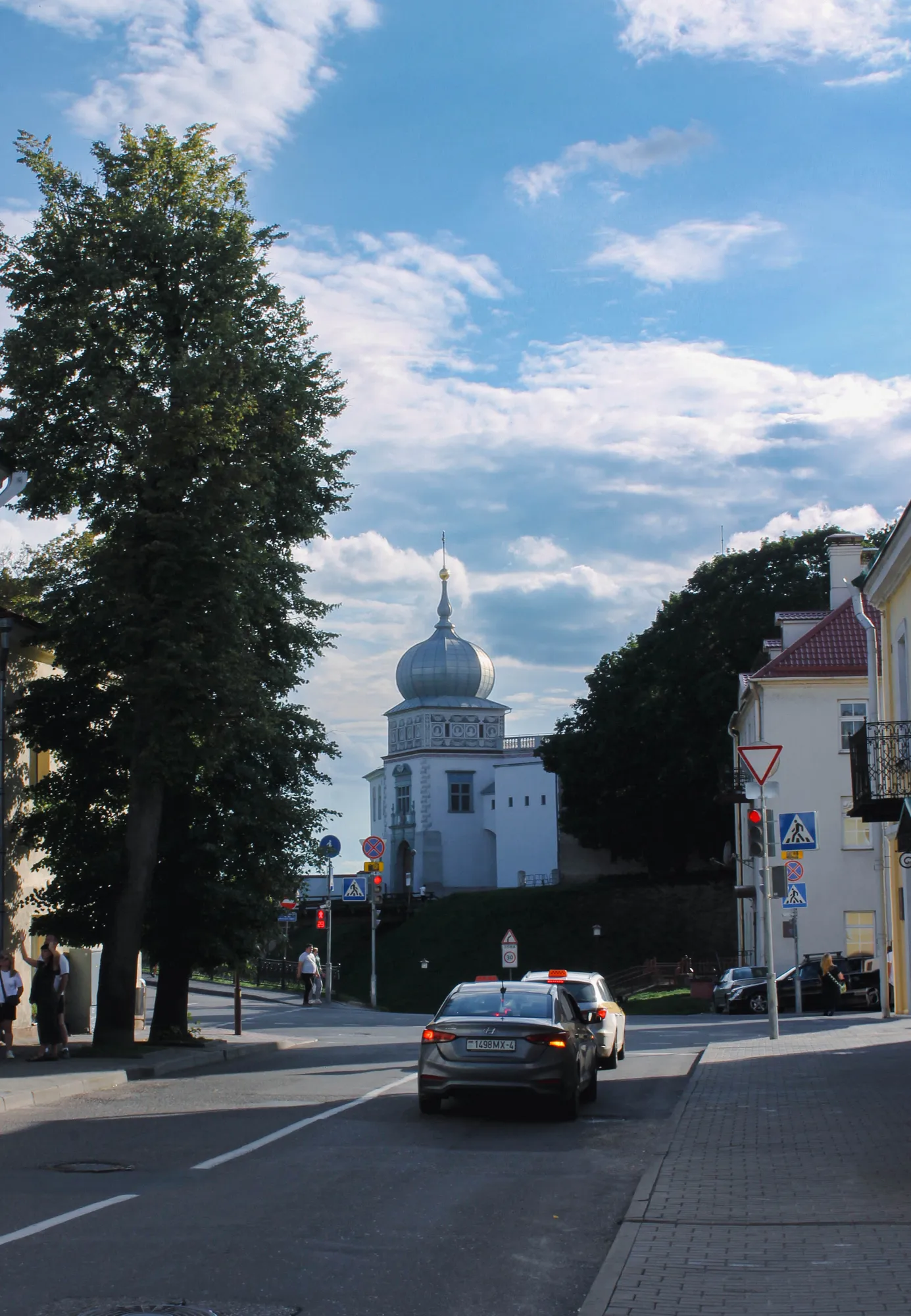
Zamkovaya Street
Zamkovaya Street
One of the oldest streets in Grodno. It likely formed in the 12th century.
Zamkova Street is a historic artery leading from the ancient citadel to the trade route toward Smolensk. It was first mentioned in documents in the 1530s–1540s.
It was previously believed that the first mention dated to 1389 — in a privilege granted by Prince Vytautas to the Jews. However, it was later established that this document had been forged in the late 16th century.
🏘 Street of Craftsmen and Merchants
In 1560, the street was called Vialikaya Zhydoŭskaya (Great Jewish Street).
Together with neighboring streets (Tesnaya and Shkolnaya), it was built up with half-timbered and wooden houses inhabited mainly by Jews.
🏰 In 1680, the street included:
● 15 Jewish stone houses ● the estate of the Grodno vogt Stefan Aleksandrovich ● the courtyard of the Polubinski family ● property belonging to the Bishop of Vilnius
🏛 Center of Political Life
Since 1673, when every third Sejm of the Polish–Lithuanian Commonwealth began to be held in Grodno, the importance of the street increased sharply.
In the 1740s, the New Castle was built here, and part of the Lithuanian Archive was transferred from Navahrudak.
By the mid-18th century, Zamkova Street became the only street in the city dominated by stone buildings.
📝 What Travelers Wrote
In 1752, traveler Wilhelm Schlemüller wrote:
“Except for the citadel, Zamkova Street, and the Market Square, all of Grodno is wooden. Beautiful wooden palaces alternate with poor huts.”
🔥 Fires and Rebuilding
● 1753 — a major fire destroyed at least seven magnate palaces (Masalski, Khreptovich, Sinyavski, Sosnovski and others) ● 1892 and 1899 — new fires that changed the appearance of the street ● Late 19th – early 20th century — 2–3-storey plastered stone houses with cast and wrought-iron balconies appeared
⚔ The 20th Century: War and Reconstruction
● World War I — Zamkova Street was almost undamaged ● July 1941 — German авиационные strikes destroyed part of the street ● 1942–1943 — dismantling of ruined buildings (reportedly carried out by ghetto prisoners)
📑 Master Plan and New Construction
● 1963 — according to the general plan, Zamkova Street was to be transformed into a boulevard leading to the future Kalozha Park ● In the late 1960s, construction of a House of Services began on the site of demolished buildings ● To open a view toward it, surviving historic buildings were also demolished, including three 18th-century stone houses For a long time, a vacant lot with a small square occupied the site.
🛠 Good News
In 2022, thanks to a private investor, three historic buildings were reconstructed, restoring their historical appearance. 📷 Pay attention: Zamkova Street is a living chronicle of Grodno. Here the religious, political, and commercial history of the city intersect. Some of the buildings you see today have been recreated based on historical models.