
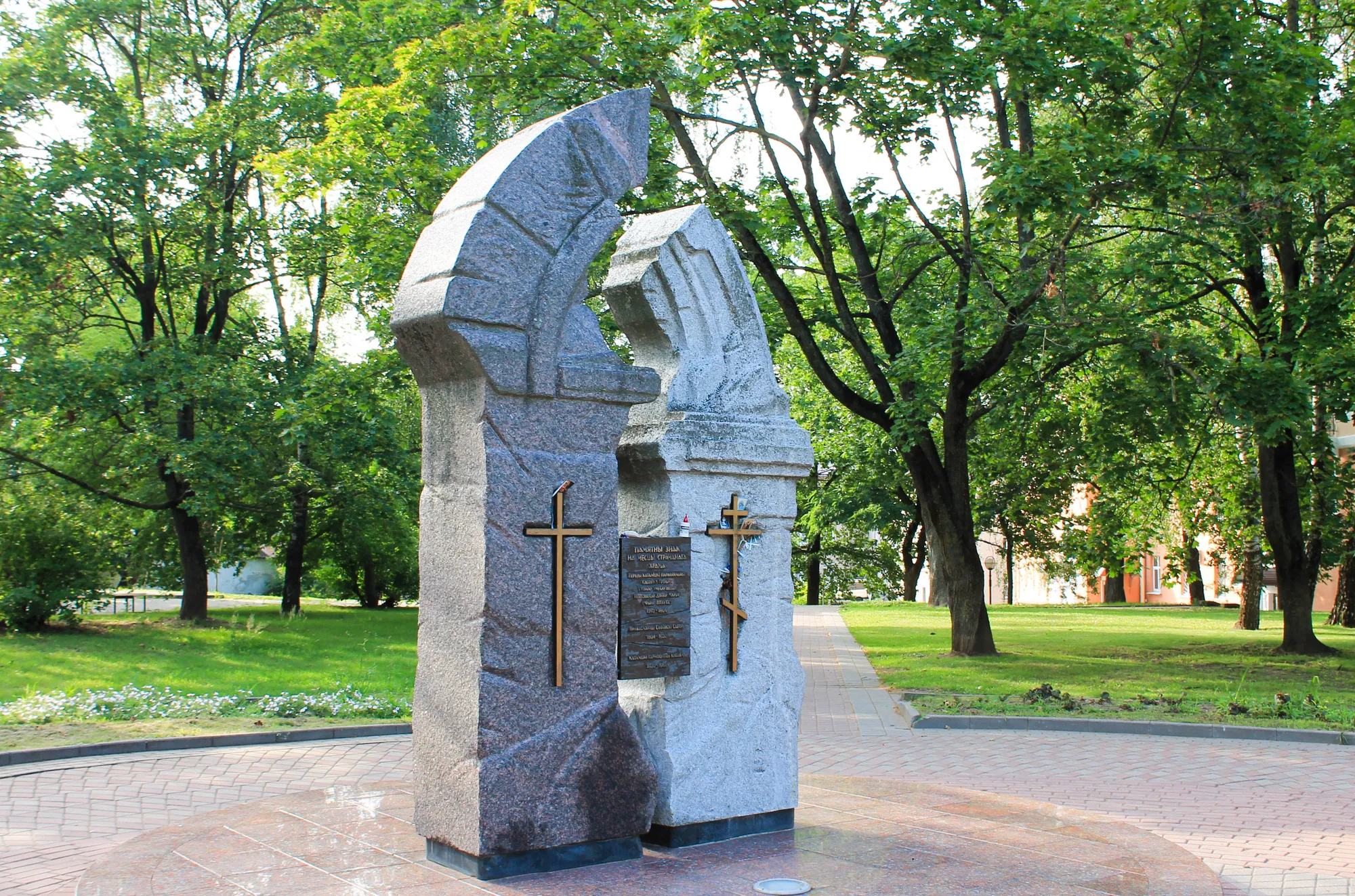
The Site of Fara Vitovta
Zamkovaya Street
The Church of the Blessed Virgin Mary — the first Catholic shrine of Grodno. A symbol of faith, history, and loss.
Here, at the corner of Sovetskaya Square and Zamkova and Oktyabrskaya Streets, once stood the city’s first Catholic church — Fara Vitovta. Its construction dates to around 1389 and is associated with Grand Duke Vytautas of Lithuania.
⛪ Early History
Originally, the church was wooden. Later it was rebuilt several times:
● in 1494 — by order of Prince Alexander ● in 1551 — at the initiative of Queen Bona Sforza
🏛 The Stone Church of Stephen Báthory
In 1584–1587, a new stone church in the Mannerist style was built nearby with funds provided by King Stephen Báthory.
Báthory intended to establish a Jesuit school in Grodno, and the church construction was part of this initiative.
According to legend, after the king’s death, his body was kept in the church crypt for more than a year before being transferred to Kraków.
🔥 Destruction and Transformations
● In the 17th century, the church was damaged by warfare ● In 1782 — by a major fire ● In 1804–1807, it was restored in the Classical style and consecrated as the Orthodox St. Sophia Cathedral
At the cathedral there operated:
● 8 church schools for children ● 4 city schools ● an Orthodox brotherhood
🏛 Russian-Byzantine Appearance
In the late 19th century, the church was rebuilt in the Russian-Byzantine style according to the design of Warsaw architect M. Chagin.
From 1919, it again became a Catholic garrison church.
In the 1930s, attempts were made to restore its original appearance, but at that time the 1600 engraving by Makovsky depicting the church was not yet known.
As a result, the building acquired features of Romanesque-Gothic architecture, not typical for the Grand Duchy of Lithuania.
❌ Demolition of the Shrine
After the war, the church was not used.
In 1958, there were plans to convert it into a cinema — the project was not realized.
🧨 On November 29, 1961, at 2 a.m., by decision of the city executive committee, Fara Vitovta was blown up.
The demolition was carried out by specialists from “Vzryvprom” in Leningrad. The rubble and bricks were used to fill city roads.
🕊 Memory
In 1965, there were plans to build a 16-storey House of Unions on the site, but the project was never implemented.
In 1994, archaeological excavations were conducted: the foundations and basements of the church were found to be well preserved and suitable for possible reconstruction.
✝ In 2014, a memorial cross was installed here, designed by Sergey Bildyuk.
📷 Pay attention: Today, a small square with a wooden cross marks the site of Fara Vitovta — a symbol of the lost church and the spiritual memory of Grodno’s residents. It is a space of silence, a reminder of what once stood here — and what may yet be restored.