
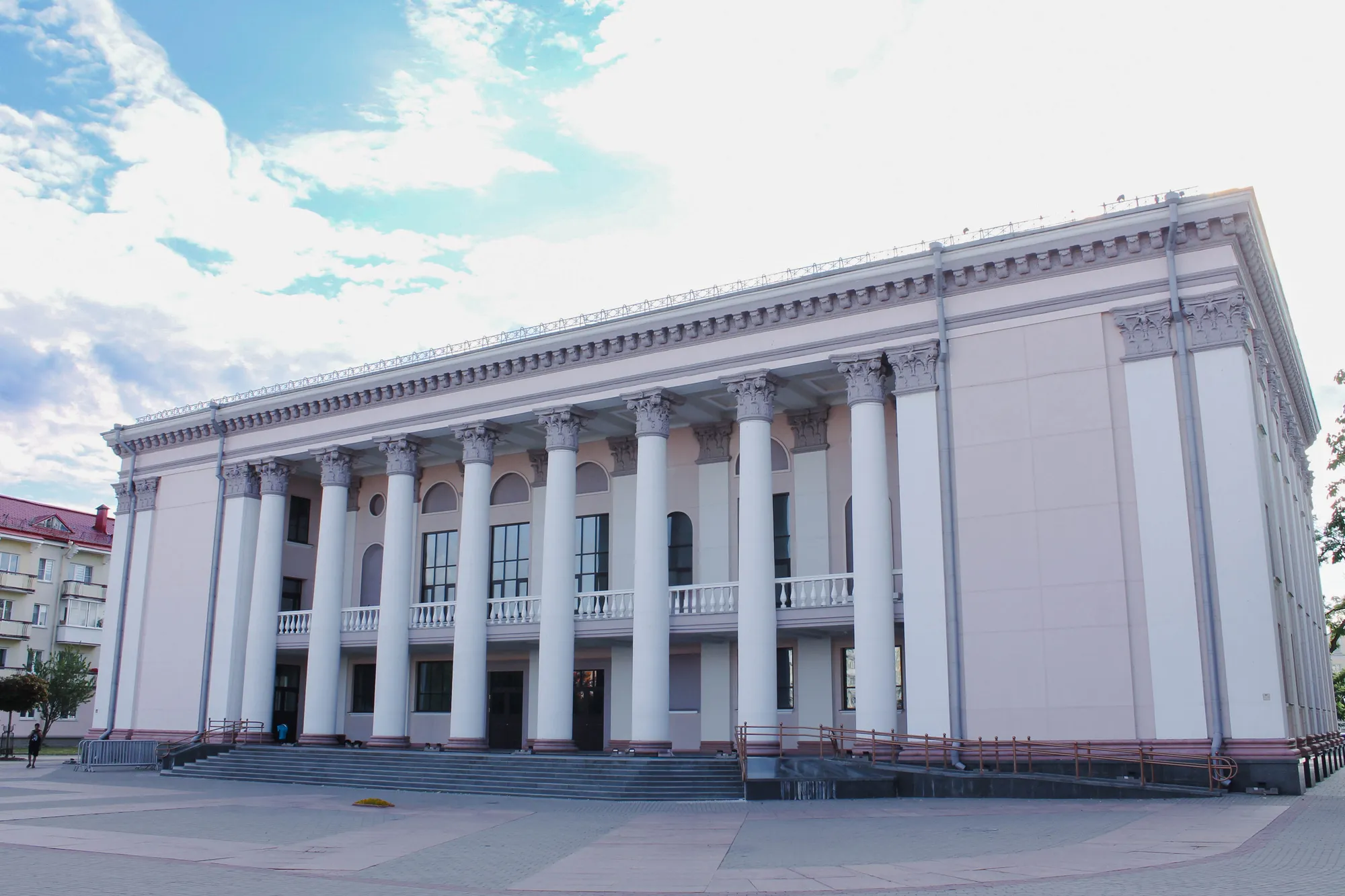
Soviet Square
st. Stefan Batory
The main square of Grodno: from town hall and fairs to postwar reconstruction.
The modern Sovetskaya Square began forming in the 15th century at the intersection of key city roads: ● Mostovaya Street — to the southwest ● Vilenskaya Street — to the north ● Ozerskaya Street — to the east
It was connected with the castle by Zamkova Street.
📜 The first written mention of the square dates to a privilege granted by King Sigismund I the Old in 1507.
After 1496, when Grodno received Magdeburg rights, the square became the center of municipal authority and trade.
🏛 Town Hall, Well, and Merchants
The town hall (built at the turn of the 15th–16th centuries) stood on the square, where the city magistrate convened.
A city well was also located here — first mentioned in 1541.
👨👨👧👦 The square was always lively: ● merchants’ stalls and guild shops ● stores belonging to the Jewish community ● fairs and public gatherings
🏰 Magnate Palaces
By the end of the 18th century, two large Baroque palaces stood here:
● the Radziwiłł Palace ● the Brzostowski Palace (formerly belonging to the Sapieha family)
🏷 Changing Names and Improvements
During the Russian Empire period, the square was officially called Parade Square (from the 1840s to 1915).
It was also informally known as Boulevard Square and Cathedral Square.
In 1824, the name Boulevard Square was first recorded on the city plan — between the Parish Church and Fara Vitovta.
Trees were planted and a fence installed — the beginnings of a small park.
💥 20th Century: War and Reconstruction
During the interwar period, the square was named after Stephen Báthory. Trade, crafts, and cultural life continued to flourish.
In 1930, even a petrol station operated here — owned by the companies “Standart-Nobel” and “Karpaty.”
📆 On June 22, 1941, the first day of the war, an air strike destroyed a significant part of the square. After the liberation of the city in July 1944, lengthy debris removal began.
🏗 Soviet Reconstruction
In 1949, the general plan of Grodno was approved. On the site of the square between the churches (the Parish Church and Fara Vitovta), it was planned to build a House of Soviets.
In 1961, the “Neman” Hotel opened on Krupskaya Street (now Báthory Street). In the corner building at the intersection of Sovetskaya Square and Parizhskoy Kommuny Street, the “Central” store operated — one of the best in the city.
🔧 21st Century: Careful Reconstruction
According to the 1973 general plan, mass demolition of historic buildings was no longer planned, though the plan was not fully implemented. By the beginning of the 21st century, the square preserved the appearance formed in the 1960s.
🛠 The last major reconstruction took place in 2005–2006.
📷 Pay attention: Today, Sovetskaya Square is the historical heart of Grodno. Amid layers of time and architectural styles, residents still gather here, celebrations take place, and city walks begin.