
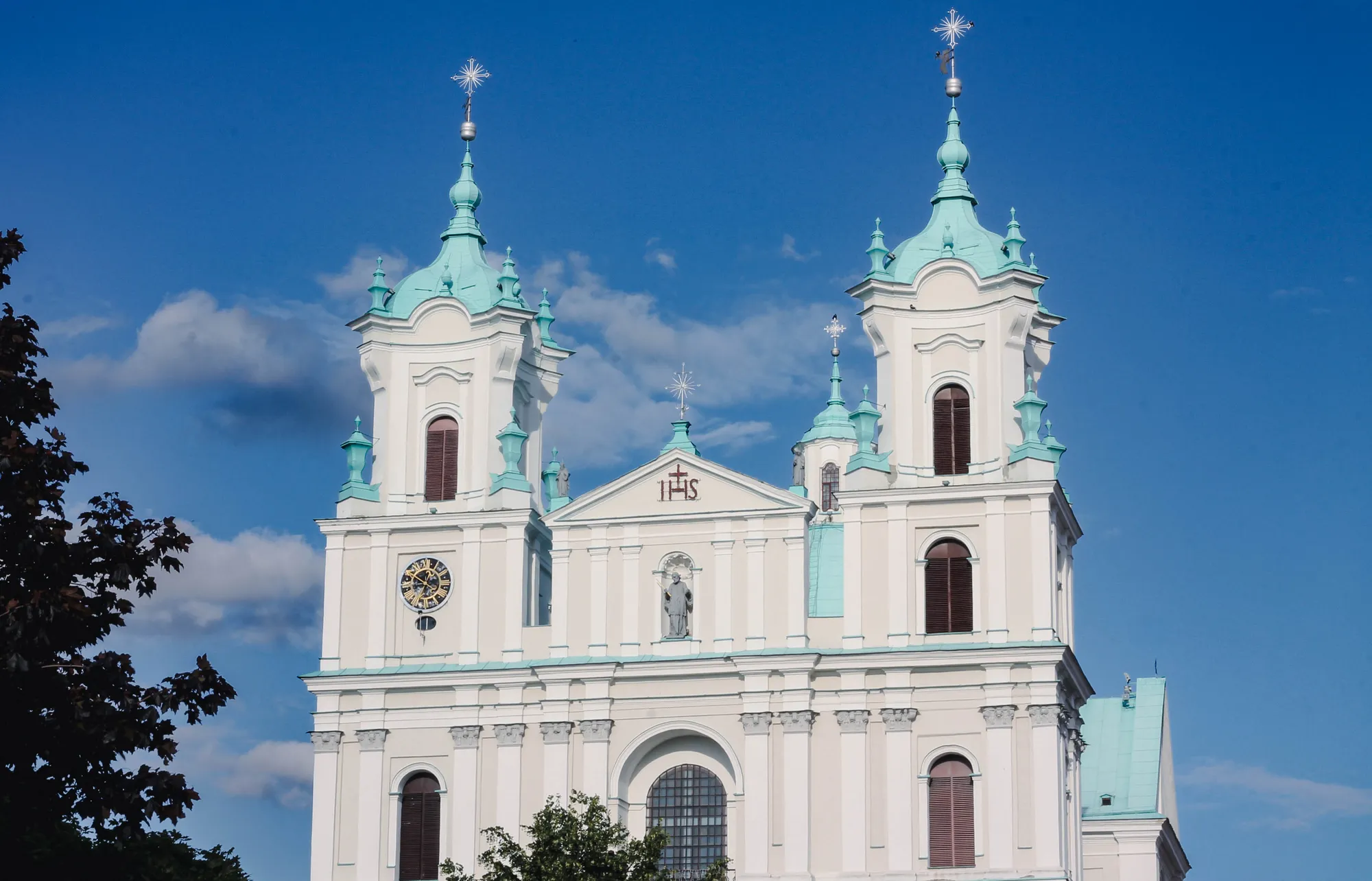
Cathedral Church
Soviet Square, 4
The main church of the Grodno Jesuits and a symbol of Baroque architecture.
⛪ The Church of St. Francis Xavier is the main Catholic church of Grodno. Built in 1678–1705 as part of the Jesuit collegium.
It is one of the most striking monuments of Baroque and Rococo architecture in Belarus and a dominant feature of the city skyline.
🏛 Architecture and Façade
The church was built according to the Baroque basilica canon:
● a dome and two towers ● a three-nave structure ● rich decorative design
The façade stands out in particular:
● in the first tier of the towers — sculptures of the Apostles Peter and Paul, as well as St. Xavier ● in the center — an orchestral balcony emphasizing the secular character of Jesuit architecture
🎨 Interior
The interior is impressive:
● a high dome on a light drum ● three naves separated by arcades ● rich stucco decoration, sculptures, intarsia, and wood carving
On the western pair of pillars is the choir with the organ, accessed by spiral staircases.
The floor is made of so-called “Swedish stone”; the walls and columns bear memorial plaques.
⛪ Main Altar
The altar is about 20 meters high.
Created in 1736–1737 by master Johann Schmidt and his students.
Features: ● three tiers ● Corinthian columns and pilasters ● crowned with a “Glory” composition featuring allegorical figures of the four continents
🕯 Other Interior Elements
● 13 altars (12 wooden, 1 stucco) ● 18th-century cast-iron chandeliers ● pulpit and confessionals with intarsia ● a 17th-century pew ● an organ from Königsberg, purchased in 1744 ● a monument to Antoni Tyzenhauz
In the Chapel of St. Michael — sculptures of figures of the Grand Duchy of Lithuania.
In the Students’ Chapel — a stucco altar of Our Lady of the Students (1760s).
🕰 Clock, Gates, and Staircase
Since 1725, a pendulum clock has been installed on one of the towers — its mechanism was lifted by a 60-kilogram stone weight.
In 1744, blacksmith Jan Birsha forged the gates for the main entrance.
In front of the entrance is a wide staircase with a statue of Christ carrying the cross (early 20th century).
📉 Fate in the 20th Century
In the 1960s–1980s, the church was closed and services were not held. There were plans to demolish it.
⚖ In 1987, permission was granted to hold Mass five times a year. Since 1988, revival began: thanks to Father Tadeusz Kondrusiewicz, the church became active again.
📅 Since April 13, 1991, after the establishment of the Grodno Diocese, the church has held cathedral status.
📷 Pay attention: Today, the Cathedral Church is one of the most majestic churches in Grodno. It is worth stepping inside for the architecture, the silence, the organ music — and the sense of connection with history.