
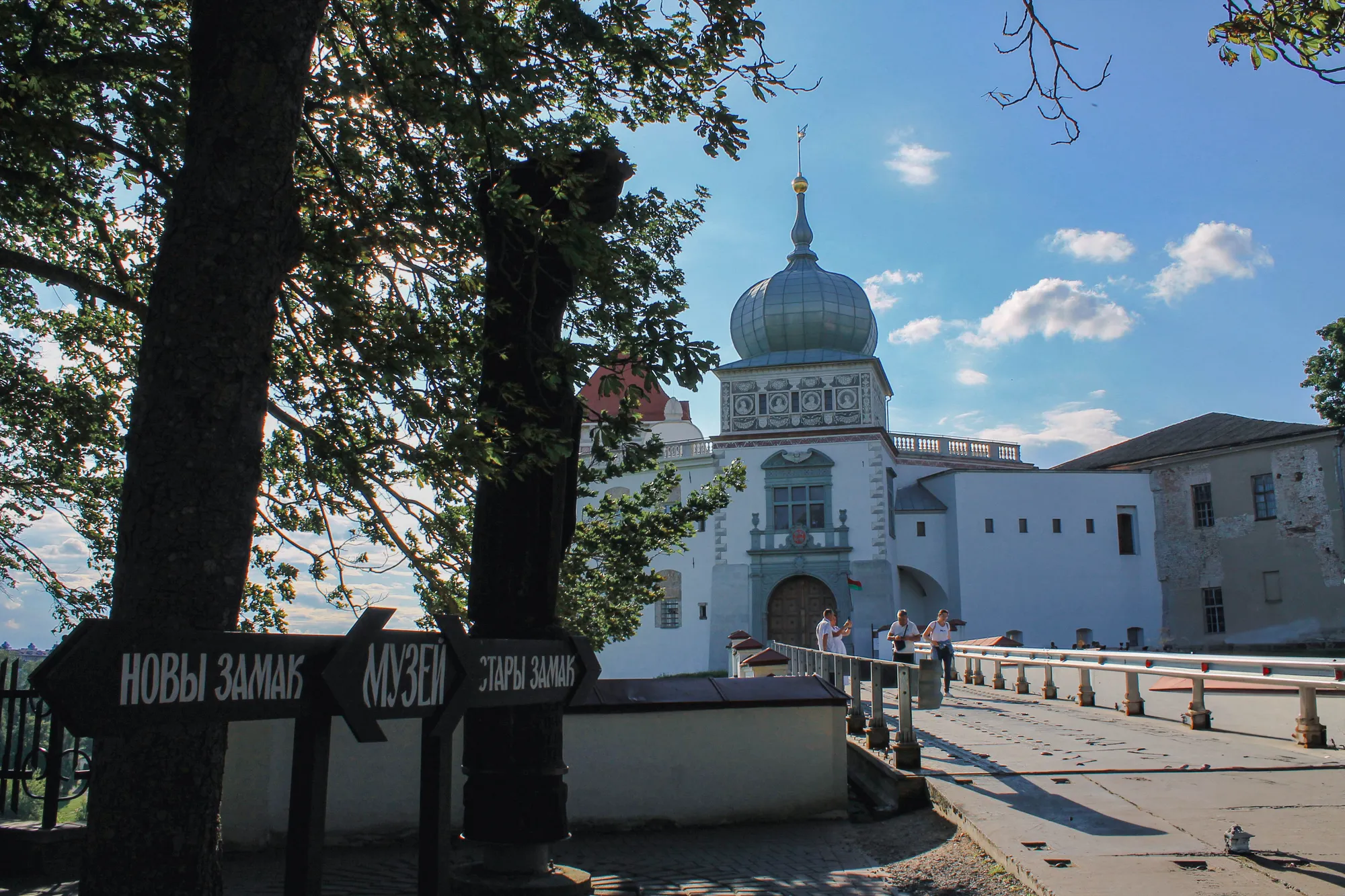
At the Monument to Vytautas between the Old and New Castles
Zamkovaya Street
📍 Point 1. At the Monument to Vytautas between the Old and New Castles Upper Castle, Old Castle, Grodno State Historical and Archaeological Museum The place where Grodno stands today was settled long before the city was first mentioned in chronicles. Initially, Baltic tribes lived here, and at the end of the 10th century Slavs came to the region. As they developed the territory, they established fortified settlements. Nature itself helped determine the location: the high, steep bank at the confluence of the Hrodnichanka River and the Neman was ideally protected. A moat was dug on the northern side, and the settlement stood as if on a natural fortress platform — almost triangular in shape, with an earthen rampart and palisade along its edges. A wooden bridge crossed a deep ravine and led to the settlement. Wooden houses stood here. Most likely, the settlement did not exist for long and was destroyed by fire. However, this did not mark the end of its history. The site remained important for Slavic princes as a strategic fortress on the border with Baltic lands.
👑 Vsevolod — the First Prince of Grodno It is believed that the founder of the local princely dynasty was Vsevolod, the son of the Volhynian prince Davyd Igorevich. After his father’s death, he was left without lands and became one of the so-called “izgoi” — princes without domains. In 1116, Grand Prince of Kyiv Vladimir Monomakh gave his youngest daughter, Agrafena, in marriage to Vsevolod and granted him lands along the Neman as her dowry. In 1127, Vsevolod was first mentioned in the chronicles as Prince of Grodno. From that moment, the history of the Principality of Grodno begins. The princely residence on the bank of the Neman became its center. By the end of the 12th century, the city stood out among other settlements in the Neman region. Architectural traces of former power: ● at least four stone churches ● a stone princely palace (terem) ● stone fortifications on the citadel
⚔ Clashes with the Crusaders In the 13th century, Grodno became an arena of struggle between the Galician-Volhynian and Lithuanian princes. Around 1277, it finally became part of the Grand Duchy of Lithuania. In 1284, the city was unexpectedly captured by the Teutonic master Konrad von Thierberg with the help of a Prussian traitor. From that time, for nearly a hundred years, Grodno constantly defended itself against the crusaders. Reasons for the attacks: ● Pagan Prussians found refuge in the city ● Grodno was used as a base for Lithuanian attacks on Prussia and Mazovia From the late 13th to the early 15th century, Grodno’s castles withstood around twenty assaults. What changed: Due to the constant threat, the construction of a powerful defensive system began: ● the Upper Castle — on the site of the ancient citadel ● the Lower Castle ● possibly city walls (this remains debated among historians)
📜 A Fire, a Monkey, and a Stone Castle In 1398, a major fire broke out in the Upper Castle. According to legend, Prince Vytautas and his wife were saved thanks to a pet monkey that woke them with loud cries. After this incident, Vytautas ordered a stone castle to be built in place of the burned wooden one. Construction was completed around 1400. The new castle: ● wall length — about 300 meters ● thickness — 2.5–3 meters ● four towers (visible in the engraving by Tünt)